The Ledger is a 421-page digital book by Ken Tsukamoto — the notebook by the telephone, the four questions, the envelopes, the cash, the subscriptions that bill while you sleep, and the March Question your household can't answer yet.
Early-bird price until the launch window closes.
Get the Book — $47Digital book (PDF) · Read on any phone, tablet or computer, or print it · 30-day money-back guarantee · Secure checkout

421 pages · 86 chapters · five appendices · a graded source ledger at the back
Maybe it's the subscription stack — the payments you could not list under oath, billing while you sleep. The budgeting-app graveyard: downloaded in January, abandoned by March, one of them possibly still charging. The paycheck that arrives, dissolves, and leaves no witnesses. Or just the quiet unease of not being able to say, even roughly, where last month went.
Different symptoms, same cause: in America, the money was made invisible on purpose — the tap that deletes the moment of paying, autopay that never asks, the permanent sale, the points that make spending feel like earning. I grew up in a house where the money lived on paper: a notebook by the telephone, envelopes in a drawer, cash in a tray, and a mother who can tell you, in her seventies, what the household spent in March of any year you name. Everyone calls that discipline. It isn't. It is machinery — a household ledger invented in 1904 and sold in stationery stores ever since, an envelope method with rules, a calendar of money rituals that make spending visible before anyone needs willpower. This book takes the machinery apart piece by piece, and most of it fits in a drawer in your house too.
It is not financial advice, and it never pretends to be. There is nothing in it about investing, debt, credit, insurance, tax, or any financial product — every decision of that kind is pointed, every time, at a fiduciary financial planner or adviser where you live. It is visibility machinery: paper, envelopes, habits, calendars. And it is not a book that says Japan got money right — there is a whole part on what American money culture does better, and I mean every row of the table.
421 pages · 86 chapters · five appendices — including the graded source ledger, a glossary, the Myth Register (where "discipline" and the frugality-in-the-blood story are formally retired), and both printables: Four Questions, Four Weeks and the Household Money Audit.
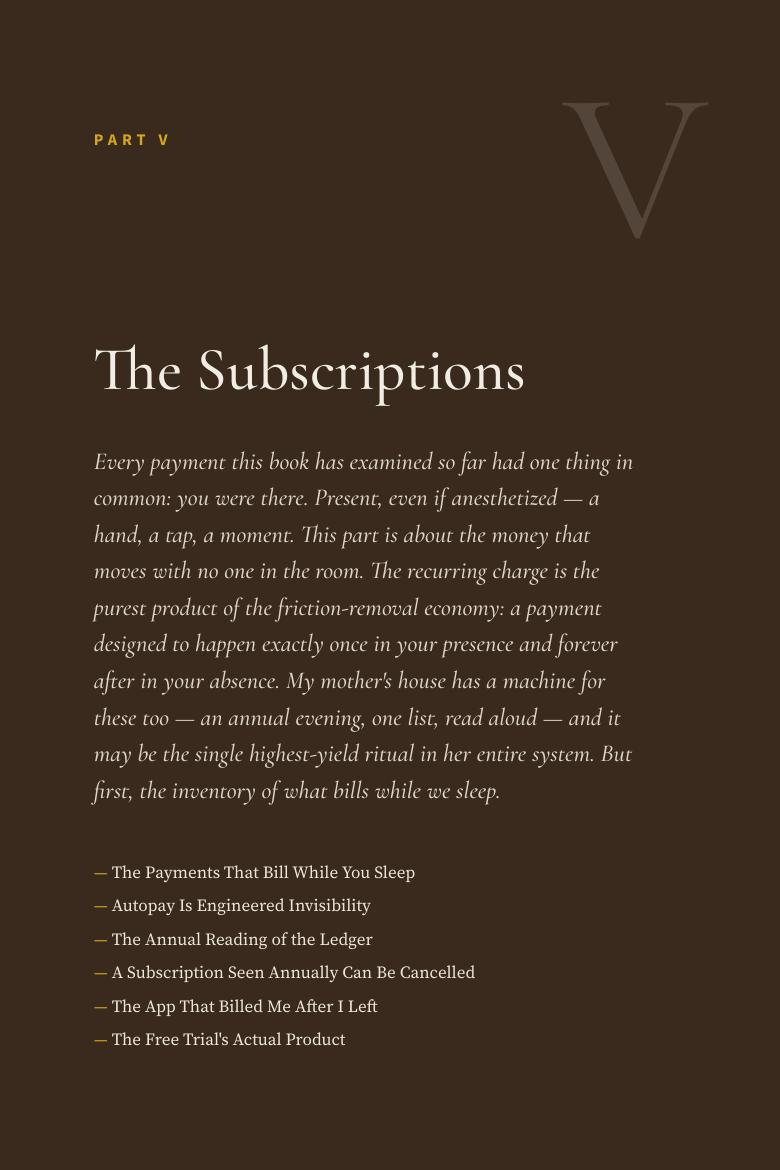
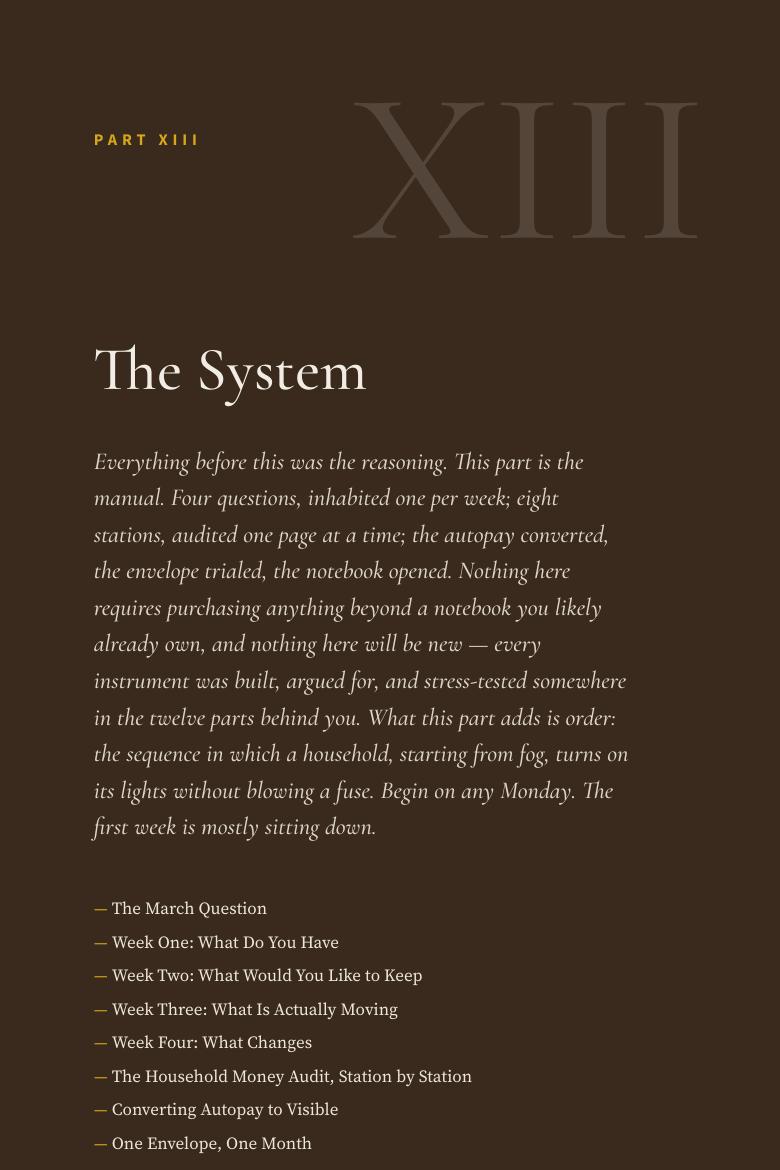
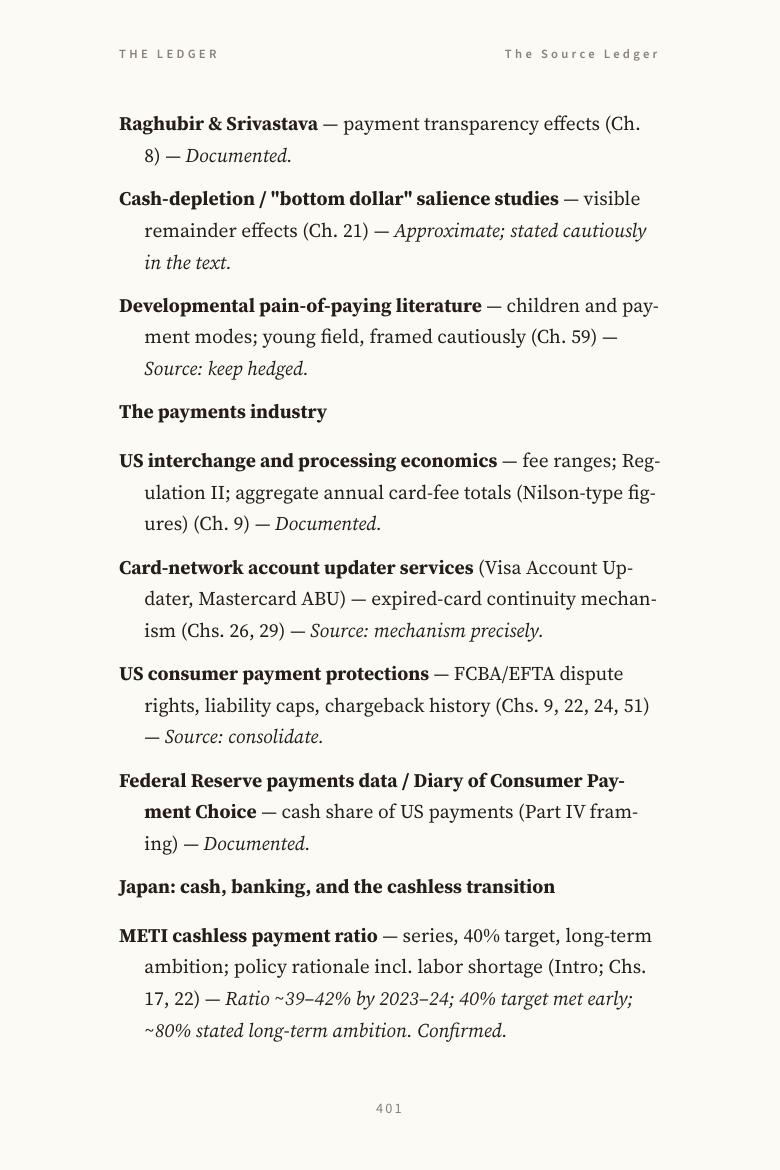
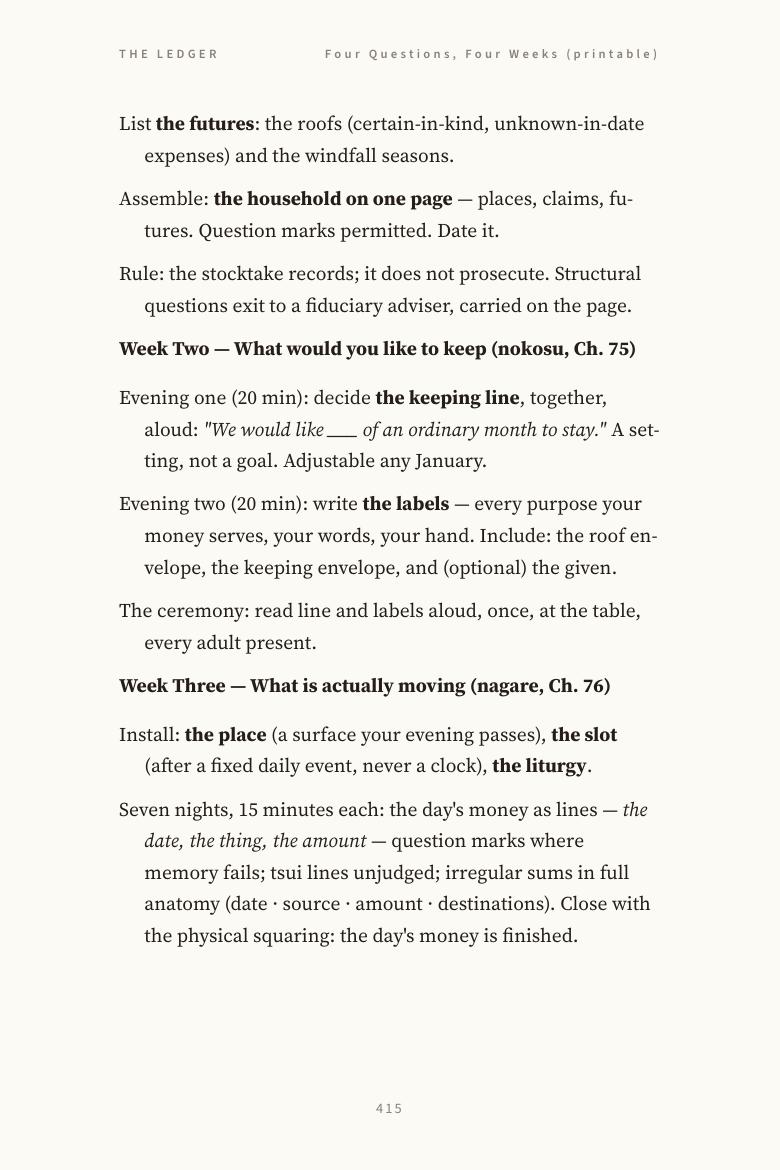
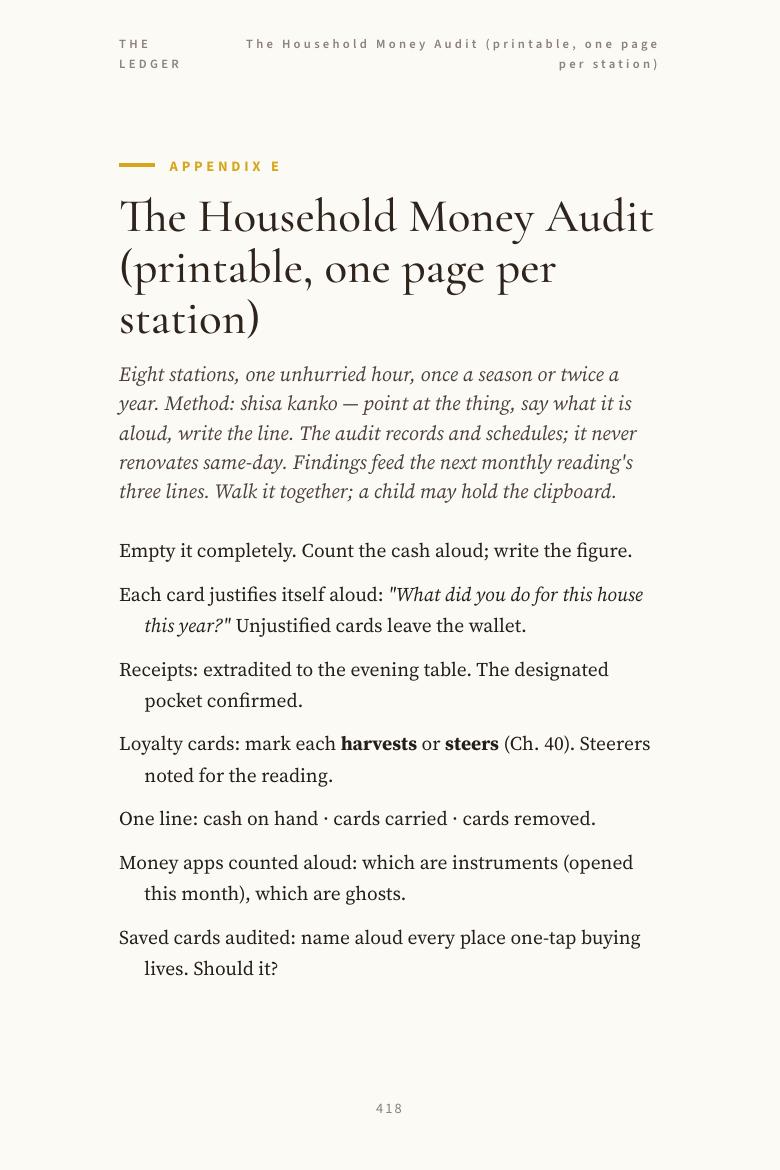
Every chapter has the same parts: the machinery, named and sourced; the memory from the house with the notebook by the telephone; the honest concession to America; and a LEDGER LINE — one line to write down tonight, one thing to make visible, and what seeing it buys. Here are eight real pages.


Tap any page to enlarge it.
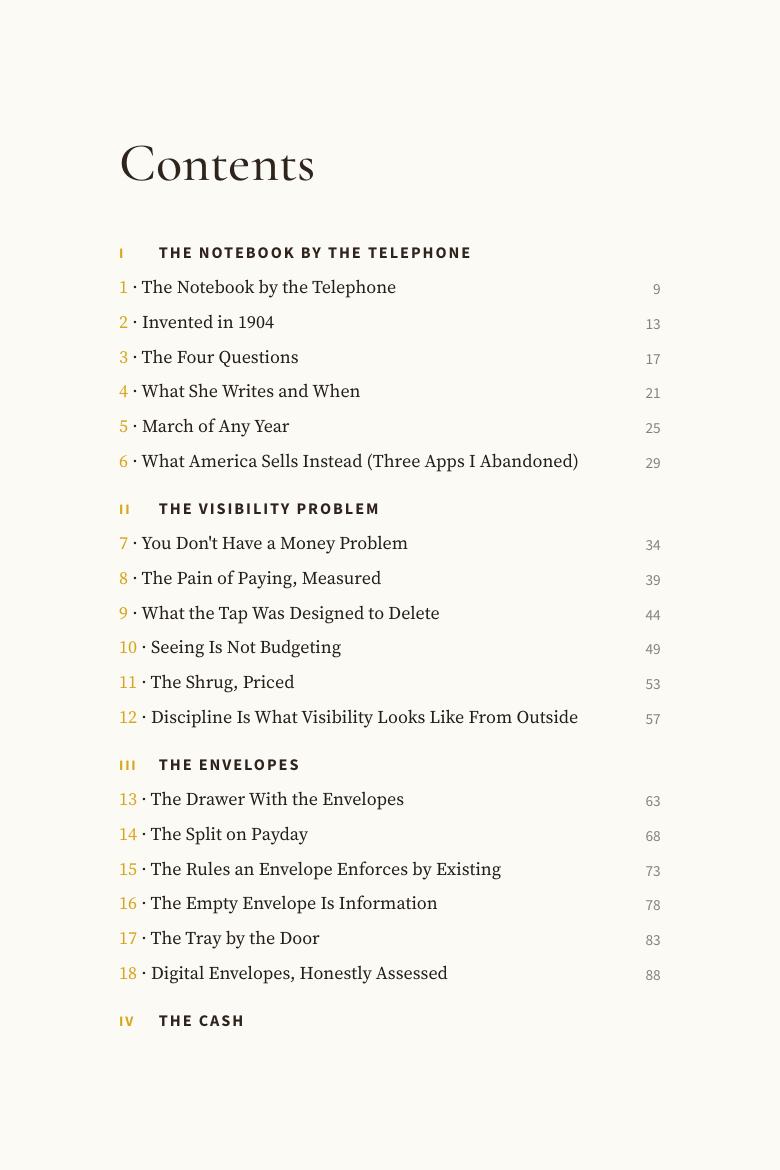
It starts with a notebook and ends with your own household's audit. Fourteen parts, in order.
Everyone here calls me Ken. My mother still calls me Kenichi. She is in her seventies, and if you name a March — any March — she can tell you what the household spent, because the answer is in a notebook on the telephone table, where a notebook has sat since before I was born. She is not a mathematician and she is not a saint. She is a woman with machinery.
Everything Americans call discipline about Japanese money, I found to be exactly that: a ledger invented in 1904 and sold beside the envelopes ever since, a cash culture the banking system itself built, rituals that make money visible before anyone needs willpower. Nobody chose any of it for its virtue. The virtue is what the machinery looks like from outside.
I am not the good example. When I finally assembled my own accounts it took an afternoon and eleven logins, and a storage-unit payment surfaced like a fish nobody remembered stocking. I have downloaded three budgeting apps and abandoned all three; one billed me after I left. This book is what I found when I stopped shopping for discipline and priced the invisibility instead — written from inside the American wallet, not from above it.
Ken Tsukamoto · The Ledger on YouTube
Email twohousesbyken@gmail.com within 30 days and I'll refund you. No form, no questions.
A checkout window opens right here on this page.
Card, PayPal or Apple Pay. Checkout is handled by Gumroad, which has processed payments for creators since 2011.
Within a minute. Open it on your iPad, phone or computer — or print it. It's yours to keep.
No. It is a digital book — a PDF file, 421 pages, set at 6 by 9 inches. It reads like a printed book on a tablet, and you can print any or all of it yourself. There is no shipping and nothing arrives in the post.
No — and the book is strict about it, deliberately. There is nothing in it about investing, debt, credit, insurance, tax, or any financial product, and it makes no promises about amounts. It is a book about visibility machinery: ledgers, envelopes, cash rituals, calendars, audits. Every decision that needs a professional is pointed, every time, at a fiduciary financial planner or adviser where you live — and what you would bring that adviser, after this book, is a lit house instead of a shrug.
No. The books are siblings, not a series — this one stands entirely on its own. If you've read the others, you'll recognise the house, the mother, and the drawer where important things live.
You already can. Every iPad, iPhone, Android phone, Mac and Windows computer opens PDFs without installing anything. Tap the link in the email and it opens. On an iPad, tap the share icon and choose "Save to Books" to keep it on your shelf.
Yes. It is set at 6 by 9 inches, which fits letter and A4 paper two pages side by side, or one page per sheet. Four Questions, Four Weeks and the Household Money Audit at the back are designed to be printed.
Yes, with a caveat. You can send the PDF to your Kindle by email and it will open, but the pages will be small on an older Kindle. It is far better on an iPad, a Kindle Fire, a laptop, or on paper.
Yes. I never see your card. Payment is handled by Gumroad, a checkout company used by hundreds of thousands of writers and creators. Your card details go to them, encrypted, and never to me. PayPal and Apple Pay work too, if you'd rather not type a card number at all.
It is 421 pages and every number in it sits in a source ledger I stand behind. A hardback of this size would be $40 to $50 in a shop, and I would have to sell it through a shop. This way you pay less than that, it arrives in a minute, and the price includes a full refund if you decide it isn't for you.
Yes. $47 is the early-bird price for the first readers. When the launch window closes it moves to $79. If you can see the $47 price on this page, it hasn't yet.
Email twohousesbyken@gmail.com and I will send the file directly to you. Gumroad also keeps a copy in your account, so you can download it again any time, on any device.
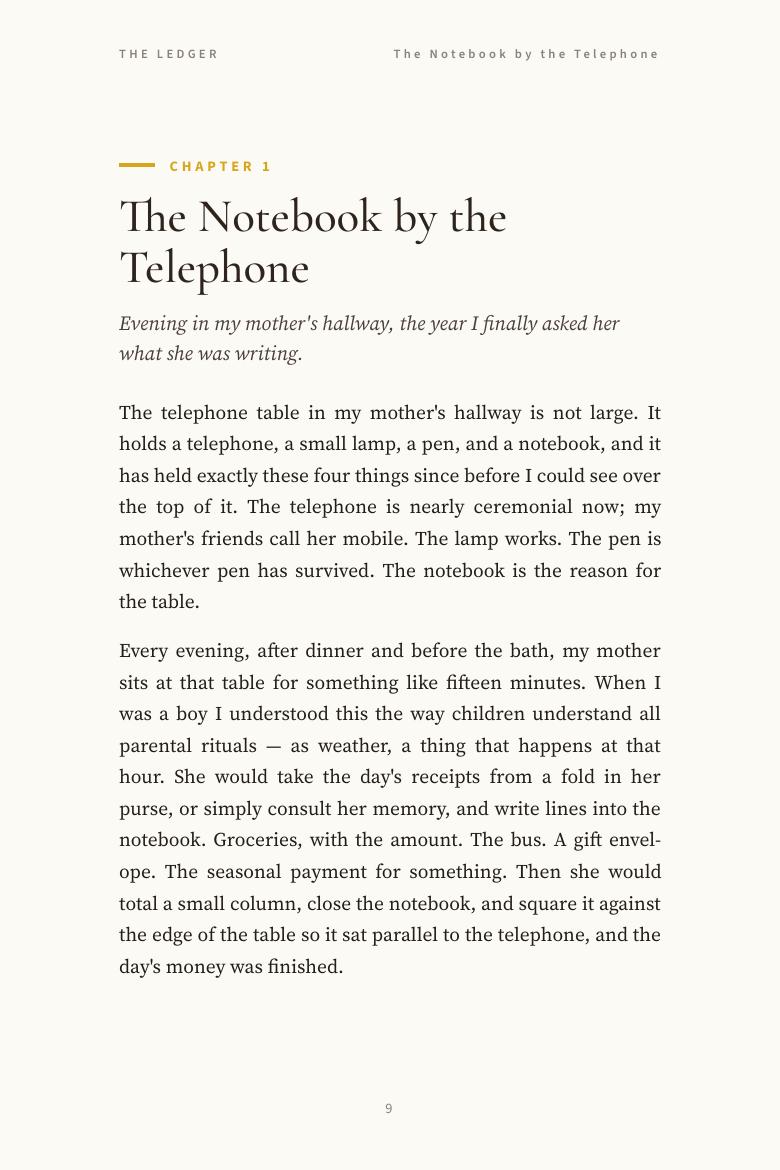
Chapter 1 — The Notebook by the Telephone. The hundred-year-old machine the whole book runs on, and the reason my mother can answer for March of any year. Enter your email and it opens right here — I'll send a copy to your inbox too.
One email with the chapter. If you buy the book later, I stop mentioning it.
A shrug is not a money problem. It is a visibility problem — and visibility is machinery, most of it on sale at the stationery store. The machinery is chapter one. The system is Part XIII.
Early-bird price until the launch window closes.
Get the Book — $47Digital book (PDF) · 30-day money-back guarantee · Secure checkout